
Driving 5G RAN efficiency: Design choices that matter
A Technical series on modern RAN architecture and future evolution
Issue 1 - MIMO and modern radio planning
How antenna technology reshaped the way we design mobile networks
Dr. Mo Nadder, PhD
Evolution of RAN planning: From 2G to 4G MIMO
As mobile networks have evolved through five generations, the way we approach Radio Access Network (RAN) planning has continuously adapted to emerging technologies.
During the 2G GSM era, radio planning was relatively straightforward. A typical sector used two antennas with large physical separation, primarily to improve uplink diversity. At that time, planning criteria were largely similar across environments—urban and rural designs differed mostly in antenna heights rather than propagation strategy.
Fast forward to the 2010s, and 4G LTE introduced a major shift with Multiple Input Multiple Output (MIMO) technologies, enabling up to four simultaneous data layers. Unlike the widely separated antennas used in 2G, the closer proximity of antenna arrays created an early form of beamforming, delivering significant downlink capacity gains.
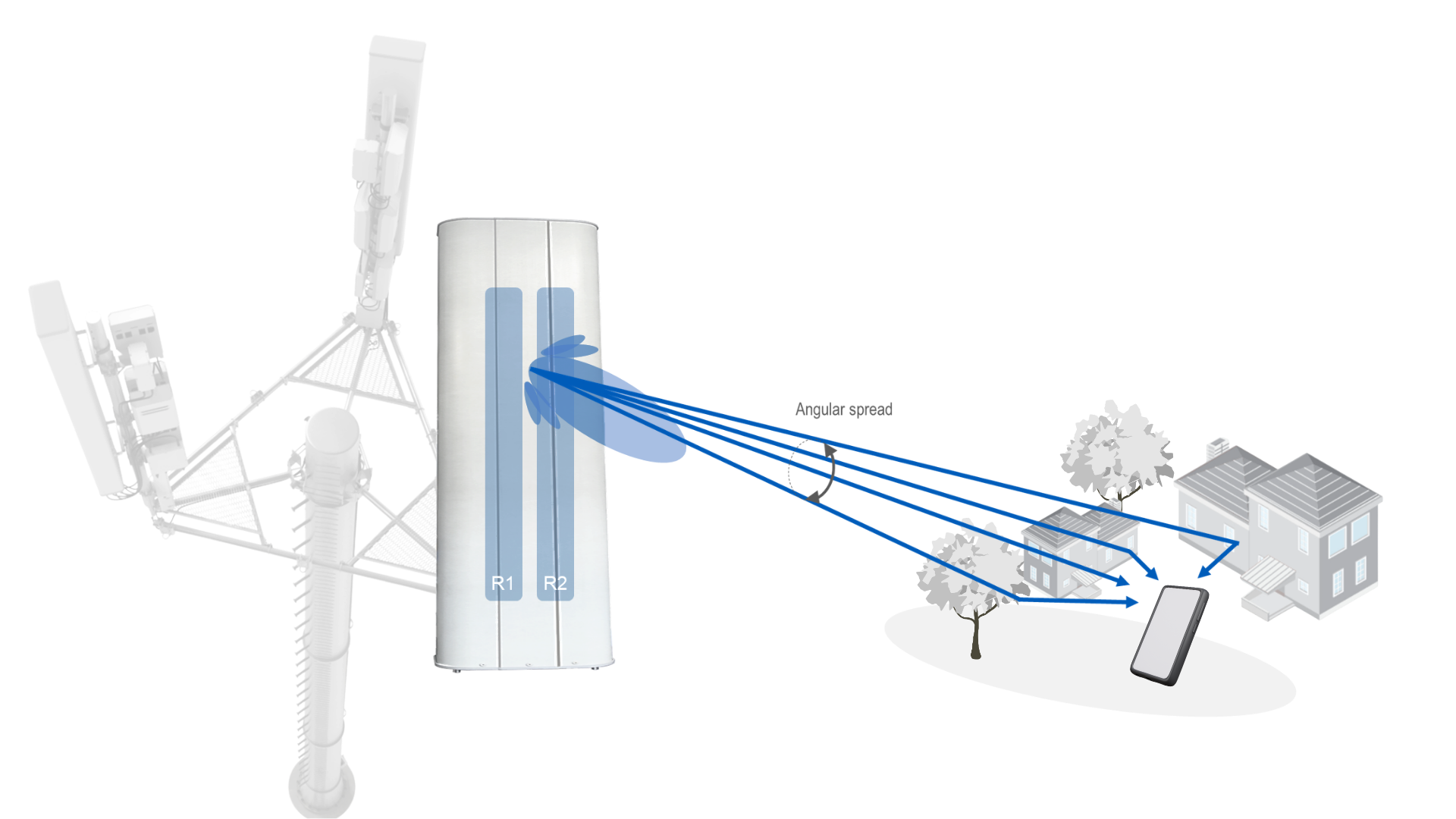
Urban environments quickly proved advantageous for MIMO. Their reflective nature created rich multipath conditions, allowing better decorrelation between MIMO streams and enabling higher MIMO rank performance. This phenomenon is better described by angular spread.
Angular spread and environment‑dependent design
Angular spread quantifies how received signal power is distributed across different propagation angles due to multipath reflections. Dense urban environments typically exhibit high angular spread, supporting more simultaneous MIMO layers and higher capacity. In contrast, rural, suburban and Stadiums generally experience fewer multipath reflections. In such environments, alternative solutions—such as multi-beam antennas—can be more effective.
5G Massive MIMO and beamforming techniques
Perhaps the most disruptive advancement in RAN planning has been in 5G Massive MIMO (mMIMO). Its highly focused, steerable, and adaptive beamforming capabilities became essential to compensate for the higher path loss associated with newer sub-6 GHz TDD frequency bands.
Because antenna patterns can now adapt dynamically, mMIMO has expanded beyond TDD deployments and is increasingly being explored in traditional FDD bands—though not without limitations.
There are several mMIMO implementation approaches. One of the simplest is the Grid of Beams (GoB) technique, where a fixed set of beam directions is predefined. This method performs well in environments with low angular spread and limited scattering, such as suburban or rural areas.
However, dense urban environments—with their complex multipath characteristics—require more advanced techniques, often referred to as generalized beamforming. In these methods, base stations generate adaptive beam patterns that respond to the radio environment. Examples include Maximum Ratio Transmission (MRT) and Zero-Forcing Precoding (ZFP).
Ultimately, the success of mMIMO beamforming depends heavily on how accurately the channel conditions and multipath characteristics are known at the transmitter.
Channel knowledge, constraints, and environment comparison
In FDD systems, where uplink and downlink frequencies are non-reciprocal, channel knowledge relies on feedback from user equipment (UE). These reports increasingly depend on newer UE capabilities—such as those introduced in Release 16—to enable advanced multipath reporting.
At the same time, practical limitations remain. Current radio systems are constrained by factors such as instantaneous bandwidth (IBW) and shared transmit power pools. Adding planning trade-offs that differ significantly from those encountered in traditional multi-beam antenna deployments.

Low-height buildings result in minimal multipaths
- High Multi-beam capacity gain.
- Wide Antenna spacing improves UL diversity gain.
- mMIMO can use basic Grid of Beams.

Dense urban areas result in high multipaths
- High MIMO layers capacity gain.
- Narrow Antenna spacing improves DL MIMO gain.
- mMIMO gains needs generalized BF.
The evolution from diversity antennas to Massive MIMO has fundamentally reshaped how we think about radio planning. The next frontier will likely depend not only on smarter antennas—but also on smarter understanding of the propagation environment itself.